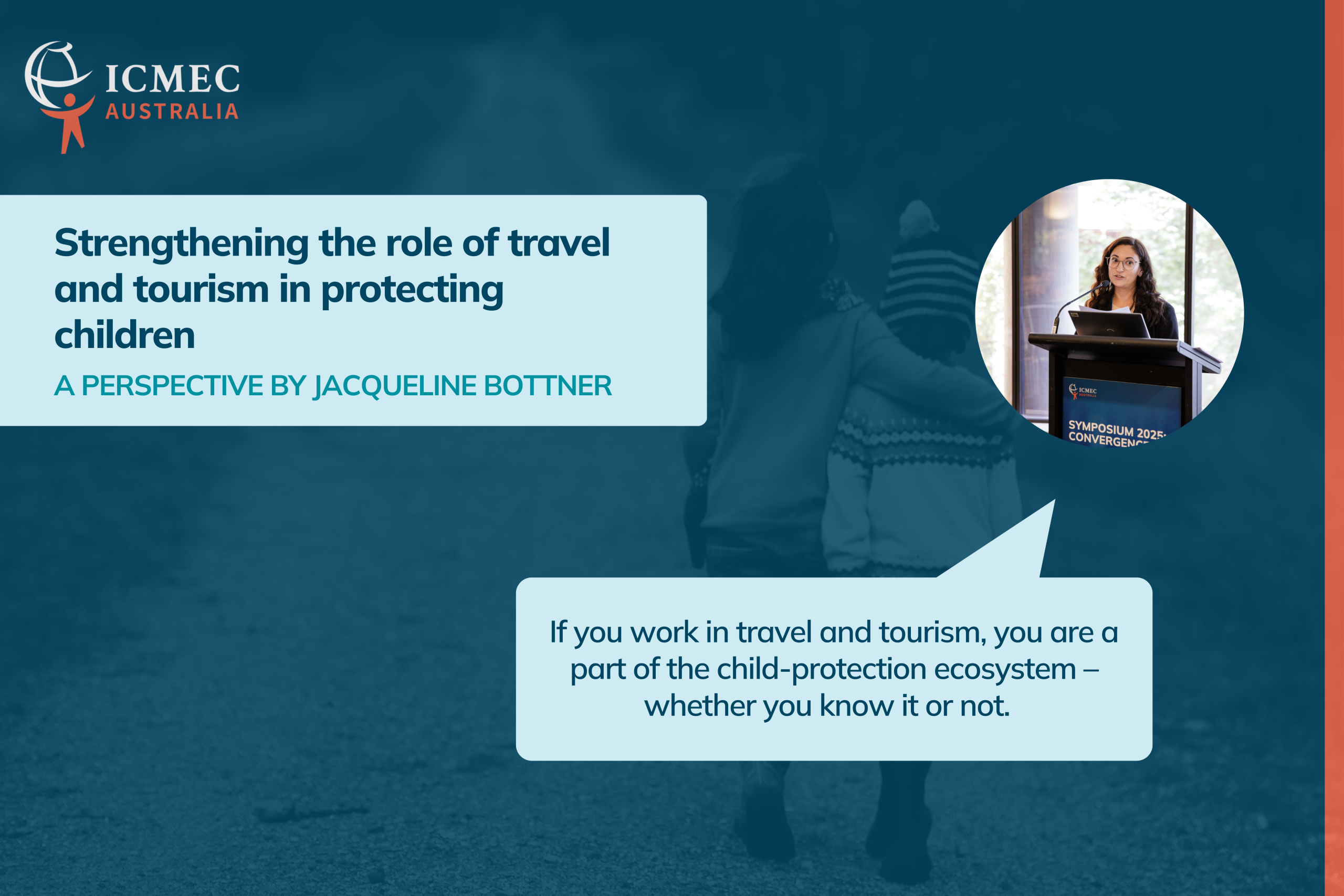
An opinion piece by Jacqueline Bottner, Senior Coordinator, Corporate Engagement ICMEC Australia.
A blind spot in responsible travel
When people think about child sexual exploitation and abuse (CSEA) in the travel and tourism industry, their minds often turn to poverty-stricken countries - places with weak child protection laws, high levels of corruption, and perpetrators imagined as shady, dangerous individuals who lurk on the margins of society.
The unfortunate reality is that CSEA is a far-reaching issue that affects children everywhere, including here in Australia. Despite having some of the world’s strongest extraterritorial laws to prosecute Australians who offend overseas, the problem is also domestic. In fact, one in four Australians have experienced child sexual abuse right here at home (ACMS 2023). Many perpetrators blend in, looking like ordinary tourists, business travellers, or even families on holiday.
While sustainability and environmental, social and governance (ESG) initiatives are gaining momentum across the travel and tourism industry, child protection is still largely absent from the conversation. It’s encouraging to see growing commitments to environmental impact and community development, but when it comes to safeguarding children, there is often a lack of awareness. The risks and realities of CSEA fit squarely within the ‘social’ pillar of ESG, which focuses on human activity and civil society challenges, and should be considered a core part of every organisation’s human rights and modern slavery frameworks.
The good news is that hospitality workers are on the front lines of guest interaction, giving them a unique opportunity to recognise warning signs, intervene in unsafe situations, and even prevent children from being harmed.
The first step toward positive change is building awareness and recognising the role the industry can play in protecting children. By starting the conversation, we can begin to create travel environments that are not only sustainable and ethical, but also safe for children.
What is CSEA and how it intersects with travel
Child sexual abuse occurs when an adult takes advantage of a child for sexual purposes - whether that’s in person or online. When abuse involves money, gifts, or any kind of exchange, it becomes exploitation.
While some offenders travel with the deliberate intent to sexually abuse children, others are opportunistic. They may not set out to offend but end up doing so when the opportunity arises and protective measures are lacking. On the flip side, offenders don’t need to be on holiday to exploit travel infrastructure to facilitate these crimes.
The online / offline connection
In today’s digital world, offenders often make first contact with children through popular messaging platforms, social media apps, and online gaming, with the aim of eventually moving the relationship offline. In these situations, young people may be led to believe they’re communicating with someone their own age, when in fact they’re being groomed by an adult.
Once a connection is made, offenders may use travel to facilitate abuse - targeting children outside of their immediate area, where they feel more anonymous and less likely to be recognised. Offenders utilise travel services like rideshare apps, booking platforms, and hotels to arrange meetings and conceal their actions. In this way, ordinary tourism infrastructure can unintentionally become part of the abuse pathway.
Human trafficking and modern slavery
Modern Slavery is an umbrella term for the use of coercion, threats, violence, and deception to exploit people and deprive them of their freedom. One form of this is human trafficking, which involves transporting a child to sexually exploit them across city, state or international borders. It's important to note that children - by virtue of their age are considered inherently vulnerable and unable to consent - which means that their exploitation can still be considered modern slavery or human trafficking even if no one ever threatened or forced them explicitly. The UN estimates that one in three detected trafficking victims worldwide is a child, and in Australia, for every victim identified, another four go undetected.
Hotels, motels, and transit hubs are often misused in these crimes, making the travel and hospitality sector a critical line of defence. According to the Australian Criminal Intelligence Commission, serious and organised crime groups are often closely involved in the perpetration of these crimes, and this can jeopardise the safety of staff and other guests.
CSEA in hotels and holiday rentals
The privacy offered by hotel rooms and short-term holiday rentals can make them attractive settings for offenders looking to exploit children.
The rise of informal and less regulated accommodation options, such as peer-to-peer home rentals and smaller budget hotels with self-service check-in kiosks, has further complicated detection and oversight. However, this crime can happen in any type of accommodation, including luxury hotels.
In a recent Australian example reported on by ABC, the offender was a high-level bank executive staying in the Sofitel Brisbane while travelling for work. The offender tasked an 18-year-old sex worker with the procurement of two young girls for him to sexually abuse. The girls were brought to his hotel room, however, after changing his mind and refusing to open the door for them, the offender contacted the front desk and requested that the girls be removed from the five-star hotel. This phone call alerted the front desk to the suspicious situation, allowing hotel staff to intervene and contact the police. In the end, the offender was arrested and charged with using electronic communication to procure children under the age of 16.
More recently, in Cairns, a 25-year-old man was charged with multiple offences after allegedly arranging to meet a teenage girl at a city hotel via social media. Queensland Police allege he supplied the girl with drugs before sexually assaulting her. The case came to light when a family member raised the alarm, prompting a police investigation that led to his swift arrest. The matter is now before the courts, with police commending the victim’s bravery in coming forward.
These examples illustrate the diverse ways in which hotels, from luxury five-star properties to budget city motels, can be exploited by offenders. Hotels and motels are often a hot spot for human trafficking and sexual exploitation as they offer easy access, the ability to pay in cash, and a level of anonymity that makes it easier for offenders to avoid detection. In some cases, limited staff oversight or infrequent room checks create additional blind spots where abuse can occur unnoticed.
Hotels globally have faced lawsuits for being complicit in human trafficking, particularly where staff failed to identify or respond to red flags. In Australia, if a hotel is found to be knowingly involved in, aiding, or allowing human trafficking or slavery, it can be prosecuted under the Criminal Code Act 1995 (Cth). This legal risk adds another layer of urgency for the industry to invest in staff training, clear reporting procedures, and child protection policies.
Sexual assaults on aircraft
Commercial flights where personal space is limited and cabins are often dimly lit, can create conditions that leave unaccompanied minors or children seated away from their guardians vulnerable to in-flight sexual assault.
According to a 2024 report by the FBI, they investigated 104 cases of sexual assault on aircraft that year, with many of the reports coming from children. These incidents often go unreported due to feelings of fear, confusion, or embarrassment, which can make it harder to intervene or hold perpetrators accountable. The Journal of Australian Lawyers cites the seating of minors in close proximity to adult strangers as an identified issue in cases of sexual assault and harassment on airlines.
But it’s not only other passengers that pose a risk to children during air travel. In some recent cases, airline staff have also been accused of assaulting minors in their care. For example, in 2020, a father sued South American airlines LATAM over the sexual assault of his 6-year-old son by a member of airline staff when the boy was flying as an unaccompanied minor. In another recent case on American Airlines, a former flight attendant taped his phone to the toilet to record people using the bathroom, including a 9 and a 14-year-old girl.
In Australia, there have been several documented cases involving staff of major airlines charged with CSEA related offences. For example, a former flight attendant was recently jailed after admitting to sending thousands of files of child sexual abuse material to contacts worldwide. In another case, an international flight attendant who travelled to the Philippines in both private and professional capacities offended on 25 separate occasions over a seven-year period.
What makes this even more concerning is that there is currently no mandatory requirement for airlines to report incidents of sexual assault onboard to police. This lack of obligation can lead to serious incidents being handled informally or not at all - allowing offenders to walk away without consequence. In some of these cases, passengers have taken legal action against airlines, highlighting a growing area of legal and reputational vulnerability.
Why this matters in travel and tourism
Child protection is not a peripheral issue; it is closely linked to the travel industry’s existing priorities and responsibilities. As more businesses adopt sustainability and purpose-led strategies, there is a growing expectation from customers that human rights risks, including child exploitation, are addressed with seriousness and accountability.
Under Australia’s Modern Slavery Act, certain businesses in every industry must identify and address exploitation risks in their operations and supply chains, and that includes risks to children. By not addressing the risks of CSEA within your organisation head on, the business can face ongoing and significant safety, financial, reputational, and legal ramifications.
Customers are also paying closer attention. Families want to book with brands they can trust, and travellers increasingly expect companies to demonstrate clear ethical standards. Internally, protecting children also means equipping staff with the support they need to feel confident in identifying red flags and responding safely, so they know that their workplace takes this issue seriously. Given that employees can also be parents or caregivers, this training can help them recognise the signs of exploitation in a professional capacity, while also equipping them with the knowledge to keep their own families safe.
When companies take a proactive approach to child protection, it not only reduces risk but strengthens their values, brand, and long-term impact. Importantly, new data highlights that traveller perceptions of sustainability are broadening. Research from Booking.com in 2025, based on global consumer insights, found that for the first time more than half of travellers now consider the social impact of tourism on local communities, not just environmental factors. This shift underscores that responsible travel is no longer just about reducing environmental footprints, but it’s also about safeguarding people in the places we visit.
What the travel and tourism industry can do
Tourism and hospitality businesses can start by incorporating child protection into their ESG and risk management discussions, recognising it as an essential component of human rights due diligence.
While small businesses might feel that they don't have the capacity to implement child safeguarding initiatives, almost all disciplines touch on this topic in some way. Providing basic training for staff, such as how to recognise signs of grooming, exploitation, or suspicious behaviour, can go a long way in creating safer environments for children and guests alike. Partnering with organisations like ICMEC Australia can help businesses access the right resources, guidance, and support to build child-safe practices that align with existing sustainability and compliance goals.
Meaningful progress often begins with small, practical steps that can have a significant impact.
Take the first step
For those in the travel and tourism industry, consider initiating conversations within your organisation about where child protection fits into your ESG strategy. Explore available opportunities to strengthen your detection and prevention of this crime and engage with organisations already working in this space.
Child protection isn’t just an ethical issue; it’s a business responsibility. And it’s one the industry has the power to lead on.
If you’d like to learn more about how to get started, please get in touch with ICMEC Australia at corporate@icmec.org.au.
About ICMEC Australia
ICMEC Australia is a specialist not-for-profit organisation that strengthens Australia’s ability to prevent and respond to child sexual exploitation and abuse (CSEA). ICMEC Australia supports government, industry, and the community to strengthen safeguards, disrupt harm, and build systems that protect children. Our work is grounded in evidence, cross-sector collaboration, and a commitment to creating safer environments for children in Australia and beyond.
References: