Join our mission in the fight against CSEA

Support us

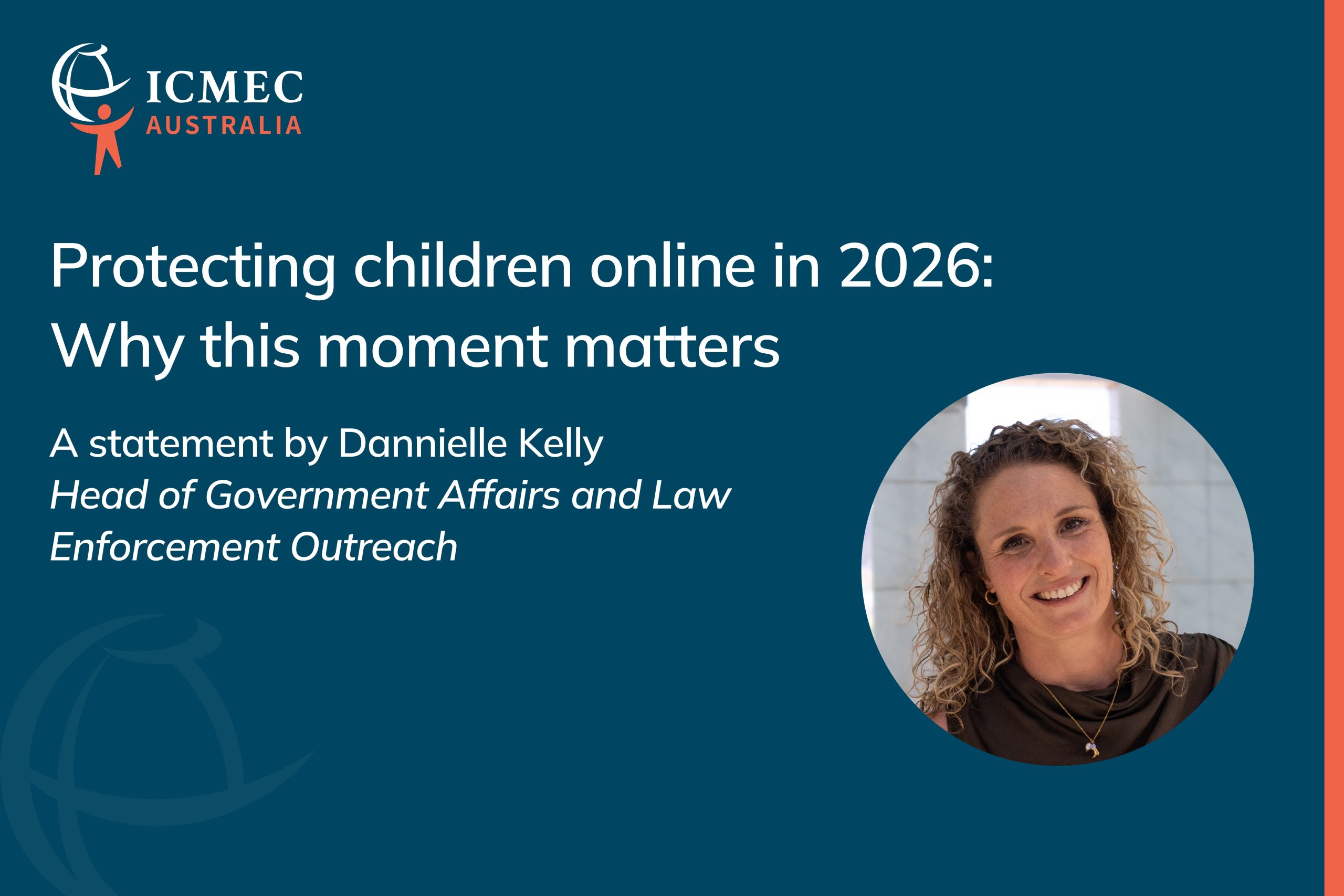
A statement from Dannielle Kelly, Head of Government Affairs and Law Enforcement Outreach.
The national focus on online harm affecting children did not arrive by chance. It exists because victim survivors, frontline practitioners, researchers, and advocates have spent years forcing uncomfortable truths into public conversation. Their persistence has helped move online child harm from a specialist concern into the broader child protection conversation, prompting greater focus from governments, regulators and industry.
As we move through 2026, the challenge is no longer awareness. The challenge is action.
Safer Internet Day plays an important role in focusing attention on online harm. For children, families, and frontline responders, however, these issues are an everyday reality, continuing to evolve as technology moves faster than policy. Grooming, sexual extortion, and child sexual exploitation are being reshaped by generative AI, encrypted platforms, and rapidly changing online behaviours. Families are often confronting this complexity, well before systems are ready to respond.
Recent enforcement action by the eSafety Commissioner has reinforced the importance of accountability in protecting children online. Strong, independent regulation provides a vital foundation for safer digital spaces, particularly when it is complemented by coordinated policy, capable frontline response, and practical collaboration across government, industry and child-focused services.
What we see consistently is fragmentation at the point where harm occurs. Families are left uncertain about where to report, children receive inconsistent responses, and frontline police are asked to manage trauma disclosures, complex digital evidence, and emerging technologies alongside their core policing duties. This gap is where ICMEC Australia focuses its work.
Late last year, we launched the pilot of our Child Abuse Response Training for Frontline Police, with a clear objective: to equip every frontline police officer in Australia with the skills and confidence to respond effectively when online harm intersects with a child’s life. The quality of that first response matters. How a disclosure is received and acted on can shape a child’s recovery and a family’s trust in the system.
Alongside this work, we continue to engage across government, industry, law enforcement, and research to align policy, prevention, and practice. Child safety does not sit neatly within one portfolio. It cuts across technology, communications, education, social services and justice. Progress depends on those parts of the system working together rather than in isolation.
Children’s lives are shaped by digital spaces every day. Our responsibility is to ensure the systems around those spaces such as policy, regulation, industry practice, and frontline response - are equally present and effective. We are past identifying the problem. What is needed now is sustained investment in frontline capability, coordinated action across government, and clear expectations on industry, so that when harm occurs, children and families are met with competence, consistency and care.
About the author
Dannielle Kelly (Danni) is the Head of Government Affairs and Law Enforcement Outreach at ICMEC Australia, where she leads strategic partnerships across government, law enforcement, industry and academia to advance efforts to prevent child exploitation. A former Australian Federal Police leader with more than 17 years’ experience, including work with the Australian Centre to Counter Child Exploitation (ACCCE), she has led organisational reform and long-term operational strategy initiatives. Her work focuses on building research-informed, cross-sector programs that strengthen national and global responses to child exploitation.
ICMEC Australia acknowledges Traditional Owners throughout Australia and their continuing connection to lands, waters and communities. We pay our respects to Aboriginal and Torres Strait Islanders, and Elders past and present.