An opinion piece by Ashley Carvalho and Charlotte Greet, Law Enforcement Outreach, ICMEC Australia
Online child sexual exploitation and abuse (OCSEA) is too large, too fast-moving, and too technically complex for any one agency or organisation to counter alone. Law enforcement, government, the corporate sector, academia and NGOs must all work together to tackle this wicked problem.
Collaboration was the theme at this year’s Youth, Technology and Virtual Communities (YTVC) conference, recently held at Bond University from 24 – 26th of August. Organised and led by Queensland Police’s Taskforce Argos, YTVC brings together law enforcement, prosecutors, child protection workers, social workers, and advocates working directly in child protection. Collaboration was front and centre throughout the conference, highlighting the critical need to foster strong partnerships across the sector to develop a coordinated response.
That principle also shapes how ICMEC Australia approaches training. There is no uniform program or solution that can be dropped into every agency, domestic or international. When an area of need is identified, we work with each individual agency to design and deliver something tailored, effective, and sustainable – so that capability uplift lasts well beyond the training room. Collaboration has been the cornerstone of our success and impact, and this partnership-first approach runs through everything we deliver.
Our Child Abuse Response Training program began exactly this way. We sat down with NSW Police to work out what the training needed to cover, combined our research with evidence-based practice to build the program, then kept going back for feedback until it was right, working closely with them until we had developed an operationally relevant and impactful training. Just under 250 officers across NSW have now completed this training, with consistently positive feedback.
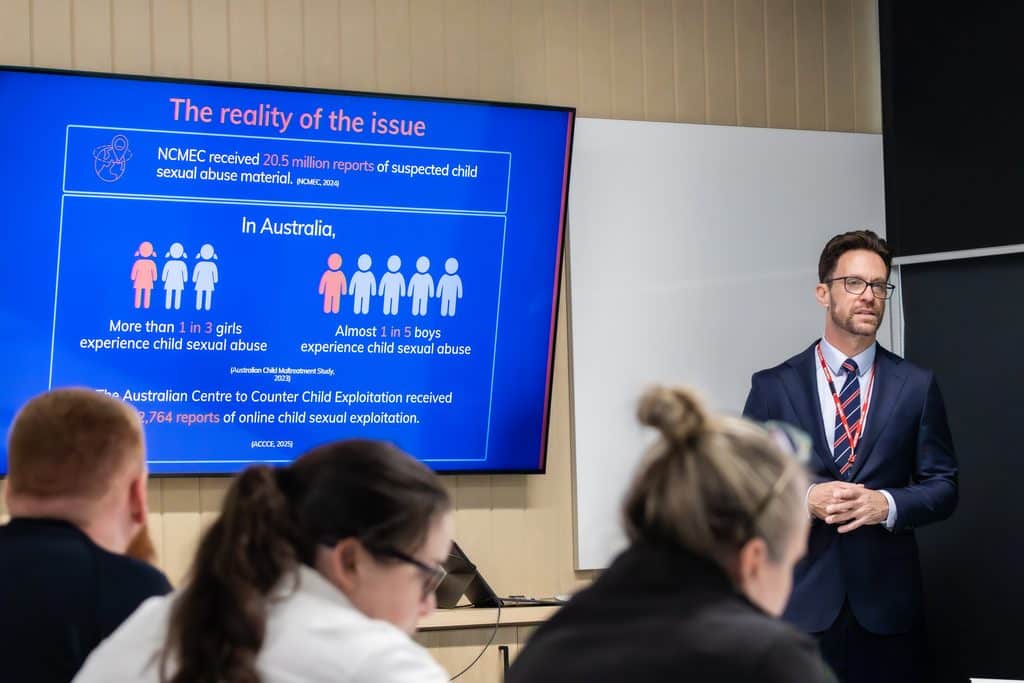
When this training is expanded to other states and territories, this same approach will be taken. ICMEC Australia will ensure the training is relevant to the jurisdiction and tailored to the needs of each agency, so every officer gets the most out of it.
“I feel I'm better equipped to respond and act on reports of this nature”- Child Abuse Response Training Attendee
Internationally, the method is the same – but the justice system changes. Working with the Malaysian Internet Crimes Against Children (MICAC) unit in Malaysia, we coordinate with international agencies already in close partnership with the Royal Malaysia Police so that information sharing stays relevant and consistent. Over 50 MICAC officers take part in monthly mentoring ICMEC Australia coordinates, which brings law enforcement experts from across the region together to support working on cases collaboratively.
Actively consulting with police and prosecutors in Malaysia then led to the development of a separate training program tailored for members of the judiciary and prosecution. We delivered this training to 19 judges and 35 prosecutors from across Malaysia in February this year, equipping participants with the knowledge and skills required for their respective roles within the criminal justice system.
This collaborative approach underpins our partnership with the Australian Border Force (ABF), with training designed in close consultation with the agency and tailored to officers’ operational environment, responsibilities, and identified needs. Since 2025, we have trained more than 100 ABF officers stationed domestically and across the Asia-Pacific, covering investigator wellbeing, case management, and online investigations.
Similarly, through our sponsorship and partnership with OSINT Industries, open-source intelligence training was delivered to almost 50 NSW and Tasmania Police officers. That training contributed directly to one arrest in 2025, but its value did not stop there. Officers kept applying and building on the skills, and the leads identified during the original training sessions produced a further five arrests in 2026. This proves what underpins our training ethos at ICMEC Australia: genuine capability development continues to generate impact long after the training day ends.
Since we began coordinating and delivering training in 2024, we have trained over 700 people through 7 unique programs. This year alone, we have trained 335 police officers domestically, and 137 professionals working in this crime type overseas.
At YTVC we heard case after case where partnerships drove meaningful operational outcomes and, ultimately, led to children being identified and rescued from harm. The consistent message was this: safeguarding children is everyone’s responsibility. Everyone must remain vigilant, no matter your role or organisation.
The conference also reinforced how much research matters, and why our work at ICMEC Australia is so uniquely placed. Our programs draw upon and translate global best practice into the Australian context, making it relevant to Australian police officers. We know that the strongest responses and impact come from pairing a solid evidence base with what frontline officers are seeing on the ground, so what we deliver is grounded in both and that is where our value lies.
Gatherings like YTVC matter precisely because they bring partners from across Australia and overseas to share knowledge, challenge thinking, and explore creative and innovative ways to strengthen our collective response to child sexual exploitation and abuse. Every piece of information can contribute to the larger picture, but if it is held in silos, it has limited value. When information is shared appropriately and combined with other intelligence, it can become the critical piece of the puzzle that leads to action. When expertise is translated and delivered across jurisdictions, and a lesson learned in one investigation reaches officers from another, the whole system moves forward together.
Every program we run starts from the same assumption: the expertise is already in the room, and the professionals doing this work are highly skilled and deeply committed. Our role is a supporting one. We ask, what would make your job easier? Can we offer solutions to make sure you have the best tools? What knowledge do you need to strengthen your skills?
By convening sectors that would not otherwise sit at the same table, we help put practical capability into the hands of the people who need it.
No one can solve these challenges alone, nor should anyone have to. The power of collaboration lies in bringing together different perspectives, skills, and expertise to achieve outcomes that would be impossible in isolation.
We’re always open to developing and coordinating trainings and programs, so if your agency is thinking about a training need, or looking for a partner to help meet one, we'd like to hear from you. Please get in touch at info@icmec.org.au
About the Authors
Ashley Carvalho and Charlotte Greet work in Law Enforcement Outreach at ICMEC Australia, where they design and coordinate training for police and frontline agencies countering online child sexual exploitation and abuse.
Media enquiries
For media enquiries, please contact press@icmec.org.au