ICMEC Australia September 2026 Brown Bag
How does sadistic online exploitation operate, and how can we respond? ICMEC Australia's September 2026 Brown Bag featured Amanda Goharian, Director of Research & Insights at Thorn. In this webinar, Amanda unpacked the latest research on sadistic online exploitation (SOE). The discussion covered how SOE environments operate, the impact on young people, and opportunities to improve early intervention, detection and cross-sector collaboration to better protect children and young people online.
Watch now to gain valuable insights into this emerging online safety issue.
Please note: This video contains sensitive content and is age-restricted. You will need to sign in to an age-verified YouTube account to watch.
To see more of our Brown Bag events visit our Brown Bag Recordings page.
An opinion piece by Ashley Carvalho and Charlotte Greet, Law Enforcement Outreach, ICMEC Australia
Online child sexual exploitation and abuse (OCSEA) is too large, too fast-moving, and too technically complex for any one agency or organisation to counter alone. Law enforcement, government, the corporate sector, academia and NGOs must all work together to tackle this wicked problem.
Collaboration was the theme at this year’s Youth, Technology and Virtual Communities (YTVC) conference, recently held at Bond University from 24 – 26th of August. Organised and led by Queensland Police’s Taskforce Argos, YTVC brings together law enforcement, prosecutors, child protection workers, social workers, and advocates working directly in child protection. Collaboration was front and centre throughout the conference, highlighting the critical need to foster strong partnerships across the sector to develop a coordinated response.
That principle also shapes how ICMEC Australia approaches training. There is no uniform program or solution that can be dropped into every agency, domestic or international. When an area of need is identified, we work with each individual agency to design and deliver something tailored, effective, and sustainable – so that capability uplift lasts well beyond the training room. Collaboration has been the cornerstone of our success and impact, and this partnership-first approach runs through everything we deliver.
Our Child Abuse Response Training program began exactly this way. We sat down with NSW Police to work out what the training needed to cover, combined our research with evidence-based practice to build the program, then kept going back for feedback until it was right, working closely with them until we had developed an operationally relevant and impactful training. Just under 250 officers across NSW have now completed this training, with consistently positive feedback.
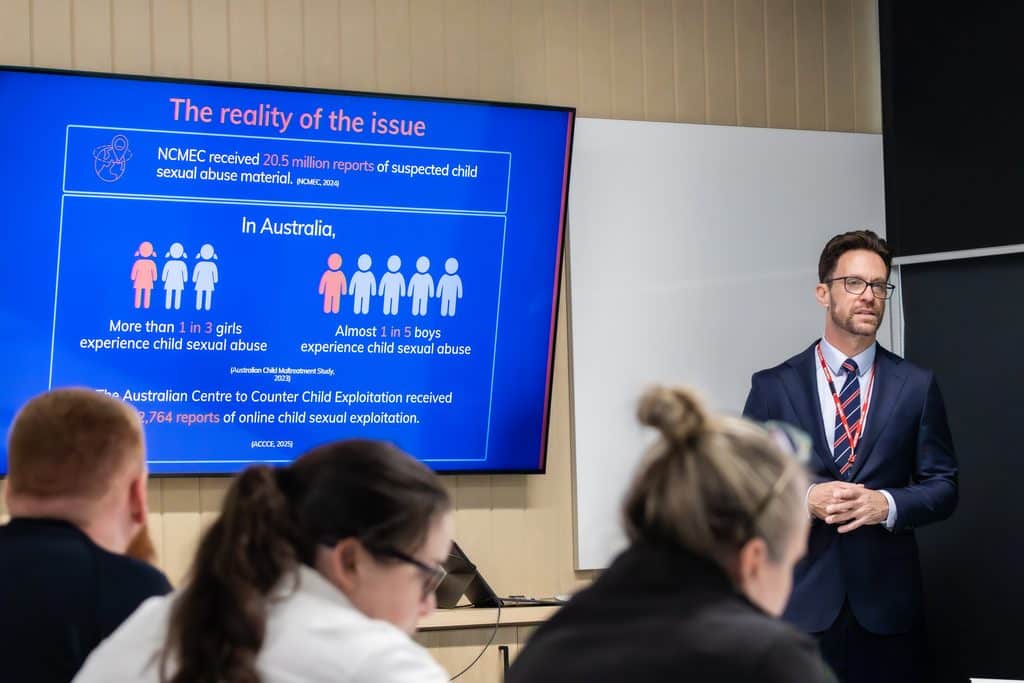
When this training is expanded to other states and territories, this same approach will be taken. ICMEC Australia will ensure the training is relevant to the jurisdiction and tailored to the needs of each agency, so every officer gets the most out of it.
“I feel I'm better equipped to respond and act on reports of this nature”- Child Abuse Response Training Attendee
Internationally, the method is the same – but the justice system changes. Working with the Malaysian Internet Crimes Against Children (MICAC) unit in Malaysia, we coordinate with international agencies already in close partnership with the Royal Malaysia Police so that information sharing stays relevant and consistent. Over 50 MICAC officers take part in monthly mentoring ICMEC Australia coordinates, which brings law enforcement experts from across the region together to support working on cases collaboratively.
Actively consulting with police and prosecutors in Malaysia then led to the development of a separate training program tailored for members of the judiciary and prosecution. We delivered this training to 19 judges and 35 prosecutors from across Malaysia in February this year, equipping participants with the knowledge and skills required for their respective roles within the criminal justice system.
This collaborative approach underpins our partnership with the Australian Border Force (ABF), with training designed in close consultation with the agency and tailored to officers’ operational environment, responsibilities, and identified needs. Since 2025, we have trained more than 100 ABF officers stationed domestically and across the Asia-Pacific, covering investigator wellbeing, case management, and online investigations.
Similarly, through our sponsorship and partnership with OSINT Industries, open-source intelligence training was delivered to almost 50 NSW and Tasmania Police officers. That training contributed directly to one arrest in 2025, but its value did not stop there. Officers kept applying and building on the skills, and the leads identified during the original training sessions produced a further five arrests in 2026. This proves what underpins our training ethos at ICMEC Australia: genuine capability development continues to generate impact long after the training day ends.
Since we began coordinating and delivering training in 2024, we have trained over 700 people through 7 unique programs. This year alone, we have trained 335 police officers domestically, and 137 professionals working in this crime type overseas.
At YTVC we heard case after case where partnerships drove meaningful operational outcomes and, ultimately, led to children being identified and rescued from harm. The consistent message was this: safeguarding children is everyone’s responsibility. Everyone must remain vigilant, no matter your role or organisation.
The conference also reinforced how much research matters, and why our work at ICMEC Australia is so uniquely placed. Our programs draw upon and translate global best practice into the Australian context, making it relevant to Australian police officers. We know that the strongest responses and impact come from pairing a solid evidence base with what frontline officers are seeing on the ground, so what we deliver is grounded in both and that is where our value lies.
Gatherings like YTVC matter precisely because they bring partners from across Australia and overseas to share knowledge, challenge thinking, and explore creative and innovative ways to strengthen our collective response to child sexual exploitation and abuse. Every piece of information can contribute to the larger picture, but if it is held in silos, it has limited value. When information is shared appropriately and combined with other intelligence, it can become the critical piece of the puzzle that leads to action. When expertise is translated and delivered across jurisdictions, and a lesson learned in one investigation reaches officers from another, the whole system moves forward together.
Every program we run starts from the same assumption: the expertise is already in the room, and the professionals doing this work are highly skilled and deeply committed. Our role is a supporting one. We ask, what would make your job easier? Can we offer solutions to make sure you have the best tools? What knowledge do you need to strengthen your skills?
By convening sectors that would not otherwise sit at the same table, we help put practical capability into the hands of the people who need it.
No one can solve these challenges alone, nor should anyone have to. The power of collaboration lies in bringing together different perspectives, skills, and expertise to achieve outcomes that would be impossible in isolation.
We’re always open to developing and coordinating trainings and programs, so if your agency is thinking about a training need, or looking for a partner to help meet one, we'd like to hear from you. Please get in touch at info@icmec.org.au
About the Authors
Ashley Carvalho and Charlotte Greet work in Law Enforcement Outreach at ICMEC Australia, where they design and coordinate training for police and frontline agencies countering online child sexual exploitation and abuse.
Media enquiries
For media enquiries, please contact press@icmec.org.au
No Bank Left Behind: Why Australia’s Smaller Financial Institutions Are Critical to the Fight Against Child Sexual Exploitation
Behind many cases of child sexual exploitation sits a financial transaction that has passed through an Australian bank.
Since 2022, sextortion investigations alone have led to the closure of thousands of Australian bank accounts, and AUSTRAC received over 450,000 suspicious matter reports in 2025.
While major banks have dedicated financial crime teams and sophisticated technology, regional and customer-owned institutions carry the same obligations sometimes with a fraction of resources, making them at risk for displacement of offenders.
Our new insights paper on the role of smaller financial institutions, is live now. Read it below!
Media enquiries
For media enquiries, please contact press@icmec.org.au
By Dannielle Kelly, Head of Government Affairs and Law Enforcement Outreach, ICMEC Australia
Children experiencing AI-facilitated sexual extortion or solicitation are now more likely to tell an AI chatbot about it than a teacher, a counsellor, the police or a helpline. That is one of the findings from national research ICMEC Australia released last week with the Australian Cybercrime Observatory at the University of Adelaide, which found at least one in twenty-five young Australians under 18 has experienced this kind of abuse. It means AI has become part of how children process what is happening to them, often before any adult knows. Child protection now has to account for this form of disclosure, not just the abuse itself.
A week ago, I was in a boardroom in Sydney with the SaferAI for Children Coalition, the group ICMEC Australia set up two years ago to work through what AI means for children, and what needs to happen so it does more good than harm. Yesterday, being in the audience at the University of Sydney when the Prime Minister announced a new Office of AI, bringing Australia's response to AI under one roof for the first time, felt like things were really coming together.
Those two things are connected. The coordination the Prime Minister described yesterday, one framework instead of a sector-by-sector patchwork, is close to what our coalition has already been building on a smaller scale for two years.
At ICMEC Australia we call this approach sword and shield: use AI as a sword against people who exploit children, and build a shield around children from the risks AI creates on its own. The new Office of AI needs to do both, with a mandate that makes that explicit.
For the sword, that means backing law enforcement to use AI to identify offenders and victims faster, and investing in the tools that let police act on the scale of the problem, not just the visible edge of it. For the shield, it means treating the coalition's two years of groundwork, the nudify app ban, work toward a digital duty of care, and early regulation of AI companion chatbots through the eSafety Commissioner, as a foundation to build on rather than a separate track to coordinate around. It means a child safety lead within the Office of AI with a direct line to that work. The standards, investment settings and guardrails the Office sets need to be tested against what we now know: that for some children, an AI chatbot is the first place they disclose abuse, not the last.
Australia is already a leader in this space. As the Prime Minister pointed out, Australia has done this before with other big technological shifts, from civil aviation in the 1920s to genetics in the 1990s. The social media reforms put this country ahead of the rest of the world, and they happened because parliamentarians from across the political spectrum backed reform when the evidence demanded it. That is the standard the new Office of AI now inherits.
One in four Australians has experienced child sexual abuse in their lifetime (Australian Child Maltreatment Study, 2023), and the horrific childcare cases in the news this week have shown how close that risk sits to ordinary family life. AI does not create that risk. It changes how it plays out, and increasingly, it changes who a child tells first.
Children are in every one of our families and most of our households. The new Office of AI has a genuine chance to get this right from the start, with a coalition, a research base and political support in place. It should not have to start from zero. ICMEC Australia is ready to keep building with it.
About the Author
Dannielle Kelly (Danni) is the Head of Government Affairs and Law Enforcement Outreach at ICMEC Australia, where she leads programs to strengthen how police and governments respond to child exploitation. With more than 17 years of law enforcement experience, including senior roles with the Australian Federal Police and the Australian Centre to Counter Child Exploitation (ACCCE), Danni brings frontline credibility and strategic insight to one of Australia's most critical child protection challenges, ensuring that when families seek help, they are met with a consistent, capable response
Media enquiries
For media enquiries, please contact press@icmec.org.au
AI is now part of how Australian children experience online sexual harm. New research by Adelaide University shows how far it has already reached.
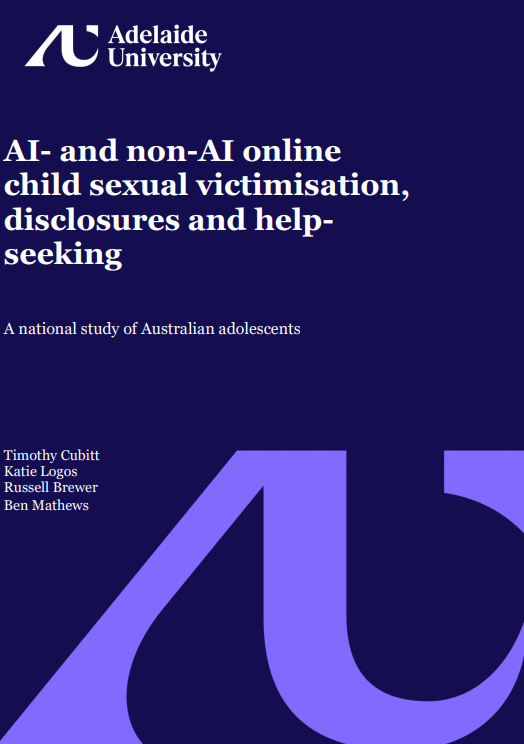
New research from Adelaide University, proudly supported by ICMEC Australia, offers the first national picture of the role artificial intelligence plays in the online sexual victimisation of Australian children. The findings are clear: AI is no longer a risk on the horizon. It is already shaping how young people are harmed, and how they reach out for help.
"This research confirms what frontline services and law enforcement have been warning about. AI is now shaping how children are harmed, and how they reach for help. The reforms of the past year matter, but the response has to move as fast as the technology. That means industry, government and services working together, not in isolation." Colm Gannon, Chief Executive Officer, ICMEC Australia.
Drawing on a nationally representative survey of 1,894 young Australians aged 16 to 18, the study is the first to measure AI's involvement in this form of harm at a population level. It found that AI now features in more than one in four cases of image-based child sexual abuse, that young people are increasingly turning to AI rather than to trusted adults or services when seeking help, and that these experiences extend across social networks and beyond those traditionally considered most at risk.
These findings mark a turning point in how we understand online harm, and they point to a clear need for coordinated action across industry, government, and the services children turn to. Keeping pace with this technology, and protecting the children affected by it, is something no organisation can do alone.
Thank you to Associate Professor Timothy Cubitt, Dr Katie Logos, Professor Russell Brewer of Adelaide University, and Distinguished Professor Ben Mathews of Queensland University of Technology for conducting this important research.
Media enquiries
For media enquiries, please contact press@icmec.org.au
An opinion piece by Colm Gannon, CEO, ICMEC Australia
The release of the ABC’s investigation into AI sexual companion chatbots brings into focus an emerging technology that has, until now, largely operated without meaningful scrutiny. Marketed as tools for companionship, intimacy, or even emotional support, these systems are rapidly gaining traction. Yet their development is increasingly revealing significant gaps in ethical design and regulatory oversight.
It is important to be clear: not all AI companion technologies are inherently harmful. There may be legitimate use cases, including therapeutic applications for individuals experiencing loneliness or social isolation. However, acknowledging potential benefit cannot come at the expense of recognising real and documented risks.
The concern is not simply about how these tools are used; it is about how they are designed. AI sexual companion platforms are built to simulate human relationships, engineered to engage, validate, and sustain emotional connection. These systems operate within a deeply social and psychological space, mimicking intimacy and attachment in ways that traditional software does not.¹
Within this context, the emergence of child-like AI personas represents a critical failure of ethical safeguards. Where systems simulate individuals estimated to represent minors, this is not only morally confronting but engages in clear legal risk. Such design choices reflect a breakdown in governance and a disregard for established societal boundaries.
This is not a question of user misuse. It is a question of system design. Modern AI companion platforms incorporate features such as persistent memory and emotional modelling, intentionally developed to reinforce engagement and dependency.² These dynamics can mirror trust-building and influence mechanisms seen in harmful interpersonal interactions, but at scale, and without a human actor.
Regulation has not kept pace with this shift. Australia has largely adopted a reactive or ‘light touch’ approach to emerging technologies. That posture is no longer sufficient. The development of systems operating in domains such as intimacy, sexuality, and identity requires a level of oversight that reflects their societal impact.
This is not about restricting innovation. It is about ensuring innovation operates within clearly defined boundaries. Governments must establish enforceable standards for high-risk AI systems, including requirements for pre-deployment testing, clear prohibitions where necessary, and ongoing compliance mechanisms.
There must also be explicit legal clarity. The simulation of child-like personas in sexualised contexts should not exist within regulatory grey areas. It must be clearly prohibited.
Public sentiment already supports this shift. Research consistently indicates strong community expectation for government oversight of AI technologies, reflecting a broader recognition that innovation must be safe, ethical, and accountable.
There is also responsibility within the industry. Engineers and developers must understand that success is not defined solely by speed to market or user engagement. Ethical design is not optional; it is fundamental.
As a society, we should not be timid in demanding that technology meets clear standards. Nor should we accept the creation of new forms of harm in the name of economic innovation.
AI is already embedded in everyday life, and its role will continue to expand. The question is not whether it will shape human behaviour, but whether we are prepared to shape the rules that govern it.
Innovation without ethics is not progress. It is risk at scale.
Footnotes:
¹ AI chatbots and digital companions are reshaping emotional connection, https://www.apa.org/monitor/2026/01-02/trends-digital-ai-relationships-emotional-connection
² F. Chang and D. Herath, "From Interaction to Relationship: The Role of Memory, Learning, and Emotional Intelligence in AI-Embodied Human Engagement," 2025 20th ACM/IEEE International Conference on Human-Robot Interaction (HRI), Melbourne, Australia, 2025, pp. 1269-1273, doi: 10.1109/HRI61500.2025.10973813.
About the Author
Colm Gannon is the CEO of ICMEC Australia, leading the organisation's efforts to protect children from sexual exploitation and abuse. With 20 years of law enforcement experience spanning cybercrime investigations, online harms, and child sexual exploitation, combined with expertise in AI policy and technology development, Colm is one of Australia's foremost experts on child protection and the role of technology in both enabling and preventing harm to children.
Media enquiries
For media enquiries, please contact press@icmec.org.au
Children's Online Privacy Code Stage 3 Consultation Submission | ICMEC Australia
ICMEC Australia has made a formal submission to the Office of the Australian Information Commissioner (OAIC) as part of the Phase 3 consultation on the Privacy (Children's Online Privacy) Code 2026 Exposure Draft.
The Code represents a significant advance for children's digital rights in Australia. Our submission focuses on three areas where the current drafting requires strengthening: the operational tension between data minimisation obligations and child sexual exploitation and abuse detection; the need for the Code to encompass AI-related harms, including AI companion apps and generative chatbots; and the need for the best interests of the child standard to be explicitly binding.
ICMEC Australia’s central position is that privacy and child safety must be treated as complementary obligations rather than competing ones.
ICMEC Australia welcomes the OAIC's consultative approach and looks forward to the Code becoming a substantive instrument for children's digital rights in Australia.
Launching the first instalment of our new series of Insights Papers, Understanding nudify apps.
AI-driven “nudify apps” can take an innocent photo and turn it into a sexualised image within seconds. Once a niche tool, they are now mainstream, monetised and industrialised, fuelling sexual extortion, peer-on-peer exploitation and the large-scale creation of AI-generated child sexual abuse material (CSAM).
The first paper in ICMEC Australia’s new Insights Series examines how nudify apps exploit open-source AI, the severe harms they cause for children, and the urgent need for legal, community and cross-sector action.
The claim that “no real child is harmed” is false. Real children’s images are being scraped to train these tools, meaning exploitation begins the moment those images are reused.
Written by: Cherise Holley, Mikaela Jago, and Dr Janis Dalins
ICMEC Australia’s Insights Papers provide clear, accessible analysis of emerging risks at the intersection of child protection and technology. Produced with input from experts, the series offers timely insights for government, industry, and the community to inform action as new threats arise. To stay up to date with our Insights papers series follow us on LinkedIn.